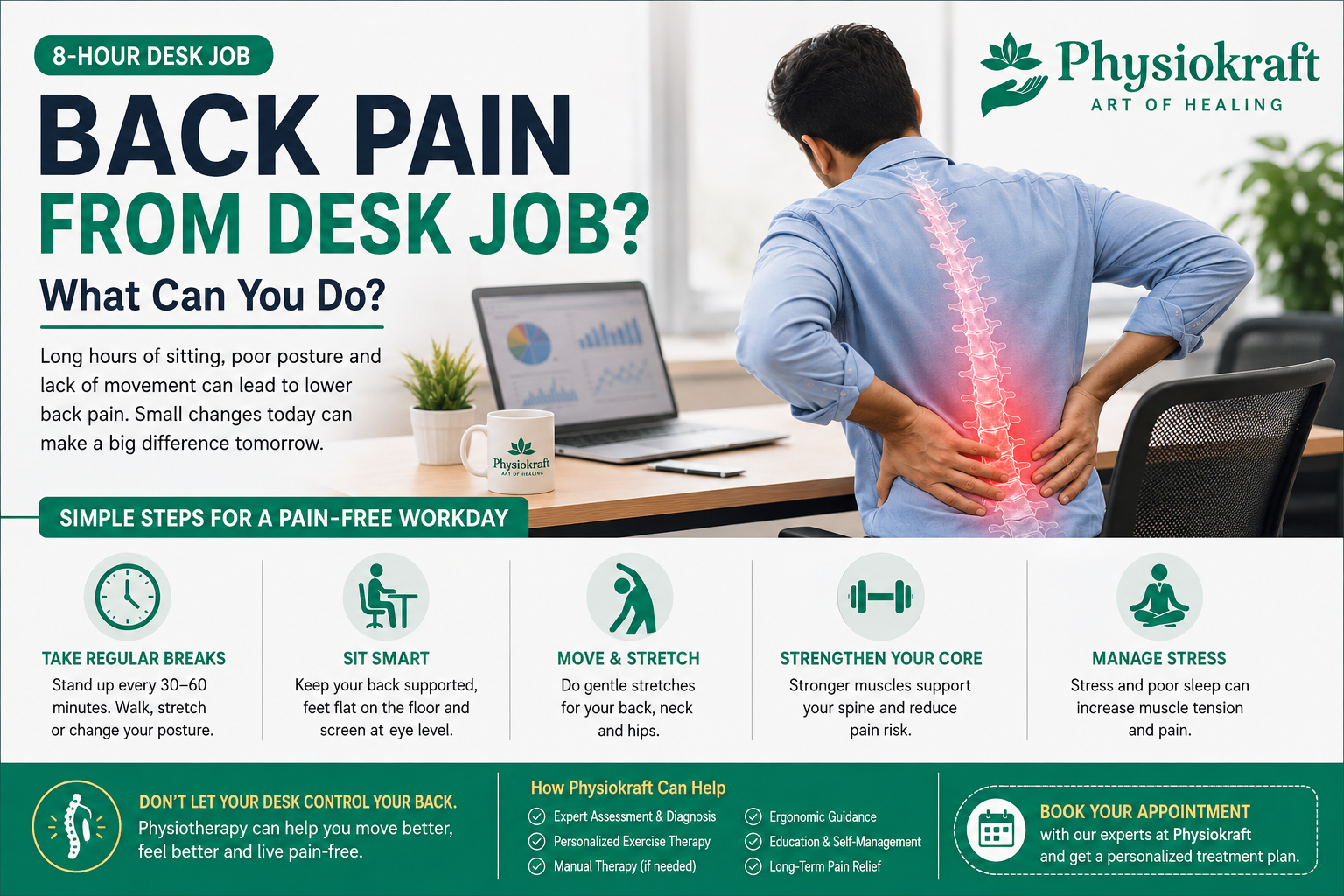

Do you start your workday feeling comfortable but notice your lower back becoming stiff, tired or painful by afternoon?
You are not Alone !
Desk job based professionals often spend many hours sitting, attending online meetings, working on laptops and moving very little between tasks. But the problem is more complicated than simply saying “sitting is bad for your back Pain.”
Recent research suggests that the way we sit and move throughout the working day may matter. Longer sitting periods, static sitting behaviour, fewer movement breaks and certain sitting postures have all been associated with low back pain from desk job among office workers.
The encouraging part is that you do not necessarily need to stop working at a desk.
You may need to change how you move during your working day.
At Physiokraft, Mahadevapura, Bangalore, we frequently assess people whose back Pain symptoms are aggravated by prolonged desk job. Physiotherapy can help identify the factors contributing to your symptoms and build a personalised plan to improve movement, strength and confidence.
Does Sitting for 8 Hours Cause Back Pain?
Not necessarily.
There is no single sitting position or number of sitting hours that guarantees you will develop back pain.
A 2025 scoping review involving 22 studies and 7,814 participants found mixed evidence regarding total sitting time and low-back pain. However, associations were more consistently reported for sitting behaviour—including prolonged static sitting and taking fewer breaks—as well as some posture-related factors.
This means focusing only on finding the “perfect posture” may miss an important part of the problem.
A more useful goal is often:
Move regularly, change positions and avoid remaining completely static for long periods.
Why Does Your Back Hurt After Sitting for a Long Time?
Back pain is usually influenced by several factors rather than one isolated cause.
For someone with a desk job, possible contributors can include:
1. Staying in One Position for Too Long
Even a comfortable position can become uncomfortable when maintained continuously.
Your body is designed to move.Regularly changing between sitting, standing and walking can vary the load placed on different tissues.
2. Reduced Movement During the Working Day
A busy office schedule can mean hours pass without meaningful physical activity.
The World Health Organization encourages people with low-back pain to remain physically active where possible rather than unnecessarily avoiding activity.
3. Reduced Strength or Physical Capacity
For some people, reduced trunk, hip or general physical conditioning may make sustained work positions harder to tolerate.
This does not mean that your core is “weak” or that your spine is unstable.
Instead, progressive strengthening can improve your body’s overall capacity to manage everyday activities.
4. Poorly Adjusted Workstation
Your chair, monitor, keyboard and desk arrangement can influence how comfortable it is to work.
For example, repeatedly leaning toward a laptop screen or working in a constrained position may make an already sensitive back uncomfortable.
Ergonomic adjustments can therefore form one part of a broader back-pain management strategy.
5. Stress, Sleep and Lifestyle Factors
Low-back pain is not purely a mechanical problem.
Sleep, stress, general physical activity, health and psychosocial factors can influence how pain is experienced.
That is why modern back-pain management usually considers the person as a whole rather than treating only the painful area.
5 Things You Can Do for Back Pain From a Desk Job
1. Break Up Long Periods of Sitting
Instead of trying to maintain one “perfect” posture for eight hours, regularly change your position.
During your working day you can:
- stand during an appropriate phone call;
- walk to get water;
- take a short movement break between meetings;
- change your sitting position;
- occasionally work standing if you have an adjustable workstation; and
- walk for a few minutes during longer breaks.
You do not need to turn every break into a workout.
The goal is simply to introduce more movement into an otherwise sedentary day.
Recent research also supports strategies that prompt office workers to interrupt sitting. A 2025 systematic review and meta-analysis found that computer-prompt interventions reduced workplace sitting time and increased daily steps, although evidence for direct musculoskeletal benefits was less certain.
2. Try Simple Desk-Break Movements
If these movements are comfortable for you, try a few gentle repetitions during your workday.
Standing Back Movement
Stand comfortably with your hands around your hips.
Gently move your trunk backwards within a comfortable range and return.
Try: 5–10 repetitions.
Chair Rotation
Sit upright with your feet supported.
Gently rotate your upper body toward one side, return to the centre and repeat on the opposite side.
Try: 5 repetitions each side.
Sit-to-Stand
Sit toward the front of a stable chair.
Stand up in a controlled manner and slowly sit down again.
Try: 8–12 repetitions.
Short Walk
Walk around your office, home or corridor for a few minutes.
The best exercise is not identical for every person. Stop an exercise if it clearly worsens your symptoms, particularly if pain starts travelling down your leg or you develop new neurological symptoms.
3. Don’t Search for the “Perfect” Sitting Posture
“Sit completely straight.”
“Never slouch.”
“Keep your spine neutral all day.”
These instructions can make people unnecessarily worried about posture.
Rather than forcing yourself to hold one rigid position throughout the day, aim for a comfortable workstation that allows you to change positions regularly.
Your next posture may sometimes be more important than your “best” posture.
4. Improve Your Desk Setup
A practical workstation setup may make prolonged computer work more comfortable.
Consider the following:
Monitor: Keep the screen positioned so you can comfortably view it without repeatedly bending or rotating your neck and trunk.
Chair: Use a stable chair that allows you to sit comfortably with adequate support.
Keyboard and mouse: Position them close enough that you do not constantly reach forward.
Feet: Keep your feet comfortably supported by the floor or a footrest where necessary.
Laptop users: If you work for prolonged periods, an external keyboard and mouse can make it easier to adjust the screen independently.
Remember:
Ergonomics is helpful, but ergonomics alone is rarely the entire solution to persistent back pain.
Exercise, physical activity, education and appropriate clinical management may also be important.
5. Strengthen Your Body Outside the Office
For recurrent or persistent back pain, exercise is one of the important evidence-supported management options.
Depending on the individual, a physiotherapy programme may include:
- trunk strengthening;
- hip and leg strengthening;
- mobility exercises;
- progressive resistance exercises;
- aerobic activity;
- functional exercises; and
- gradual exposure to movements or activities that have become difficult.
A recent systematic review of workplace interventions found that exercise interventions consistently improved pain and functional outcomes in people with chronic musculoskeletal disorders. Multicomponent programmes combining exercise, ergonomic strategies and education produced particularly consistent health benefits.
The World Health Organization also recommends exercise programmes and education as components of care for adults with chronic primary low-back pain.
Is a Standing Desk the Solution?
A sit-stand desk can be useful, but it is not a magic treatment for back pain.
Research indicates that sit-stand workstations can substantially reduce occupational sitting time. However, simply replacing eight hours of sitting with prolonged standing is not necessarily the goal.
A better principle is:
Sit → change position → stand → walk → repeat.
Think of a sit-stand desk as a tool that gives you more opportunities to vary your working position.
When Should You See a Physiotherapist?
Consider a physiotherapy assessment if:
- back pain keeps returning;
- sitting repeatedly aggravates your symptoms;
- pain is interfering with work, exercise or sleep;
- you have stopped activities because you are worried about your back;
- you experience pain spreading toward your buttock or leg;
- your mobility feels increasingly restricted; or
- symptoms are not improving as expected.
At Physiokraft Physiotherapy Clinic Mahadevapura, Bangalore, our expert physiotherapist can assess more than your sitting posture.
Your assessment may include your symptoms, movement, strength, work demands, activity levels and other factors that may be contributing to the problem.
When Back Pain Needs Urgent Medical Attention
Most episodes of low-back pain are not caused by a dangerous condition.
However, seek prompt medical assessment if back pain is accompanied by concerning symptoms such as:
- new loss of bladder or bowel control;
- numbness around the genital or saddle region;
- significant or rapidly worsening leg weakness;
- severe pain following significant trauma; or
- back pain accompanied by significant unexplained systemic illness or symptoms.
These symptoms should not simply be treated as ordinary desk-related back pain.
How Physiokraft Can Help With Desk-Related Back Pain
At Physiokraft Physiotherapy, Mahadevapura, Bangalore, treatment begins by understanding why your back pain is affecting you rather than applying the same treatment to every patient.
Depending on your assessment and clinical needs, your physiotherapy programme may involve:
Individual Assessment
We assess your symptoms, movement, strength, daily activities and work-related aggravating factors.
Exercise Rehabilitation
A progressive exercise programme can help improve strength, mobility and your capacity to manage work and everyday activities.
Manual Therapy When Appropriate
Hands-on treatment(Myofascial therapy) may sometimes be used as part of a broader rehabilitation programme rather than as the only solution.
Ergonomic Guidance
Your sitting habits and workstation can be reviewed to identify practical changes that are realistic for your job.
Self-Management Education
Understanding your back problem can reduce unnecessary fear and help you confidently return to normal activity.
The objective is not simply short-term pain relief.
The goal is to help you move better, build capacity and manage your back confidently during work and everyday life.
Frequently Asked Questions
Can sitting for 8 hours cause lower-back pain?
Long periods of sitting may be associated with low-back pain in some office workers, but sitting time alone does not explain every case. Static sitting, limited movement breaks, posture, physical activity and individual factors may all contribute.
How often should I get up from my desk?
There is no single movement-break interval proven to be ideal for every person. A practical approach is to avoid remaining completely static for prolonged periods and build short movement opportunities naturally into your workday.
Is walking good for desk-job back pain?
Walking is a simple way to increase physical activity and interrupt prolonged sitting. Depending on your condition, it can form part of a broader activity and rehabilitation programme.
Should I use a lumbar support?
Some people find temporary support comfortable, but a support should not replace movement, exercise or appropriate assessment when pain persists.
Is a standing desk better for back pain?
A sit-stand desk can reduce occupational sitting, but standing continuously is not necessarily better. Alternating positions and staying physically active is a more practical strategy.
Which exercise is best for lower-back pain?
There is no single exercise that is best for everyone. Exercise selection should consider your symptoms, abilities, preferences and goals. Persistent or recurrent symptoms may benefit from an individual physiotherapy assessment.
Can physiotherapy help back pain caused by desk work?
Physiotherapy can help by assessing factors contributing to the problem and using strategies such as exercise, education, activity modification and, when appropriate, manual therapy and ergonomic advice.
Don’t Let Your Desk Job Control Your Back Pain
An eight-hour desk job does not mean you have to accept daily back pain.
Instead of searching for one perfect chair, one perfect posture or one temporary treatment, focus on building a workday that includes movement, exercise, position changes and better physical capacity.
If back pain is affecting your work or daily activities, an individual assessment can help identify what needs to change.
Physiokraft Physiotherapy
Mahadevapura, Bangalore
Call: +91-6360834019
Book a physiotherapy assessment for persistent or recurrent back pain and get a rehabilitation programme designed around your symptoms, work and lifestyle.
Evidence Used for This Article
Alaca N, Acar AÖ, Öztürk S. (2025). Low back pain and sitting time, posture and behavior in office workers: A scoping review. Journal of Back and Musculoskeletal Rehabilitation.
World Health Organization. WHO guideline for non-surgical management of chronic primary low back pain in adults in primary and community care settings.
Recent systematic review (2026). Workplace interventions for chronic musculoskeletal disorders: a systematic review. The review evaluated exercise, ergonomic and multicomponent workplace interventions.
Recent systematic review/meta-analysis (2025). Research evaluating computer prompts for interrupting sedentary behaviour among office workers.
Recent systematic review (2024). Research evaluating sit-stand desk interventions and reductions in occupational sedentary behaviour.
Medical Disclaimer
This article is intended for general educational purposes and does not replace an individual medical diagnosis or treatment. Back pain can have different causes. Seek assessment from an appropriate healthcare professional if symptoms are severe, worsening, associated with neurological changes or causing concern.