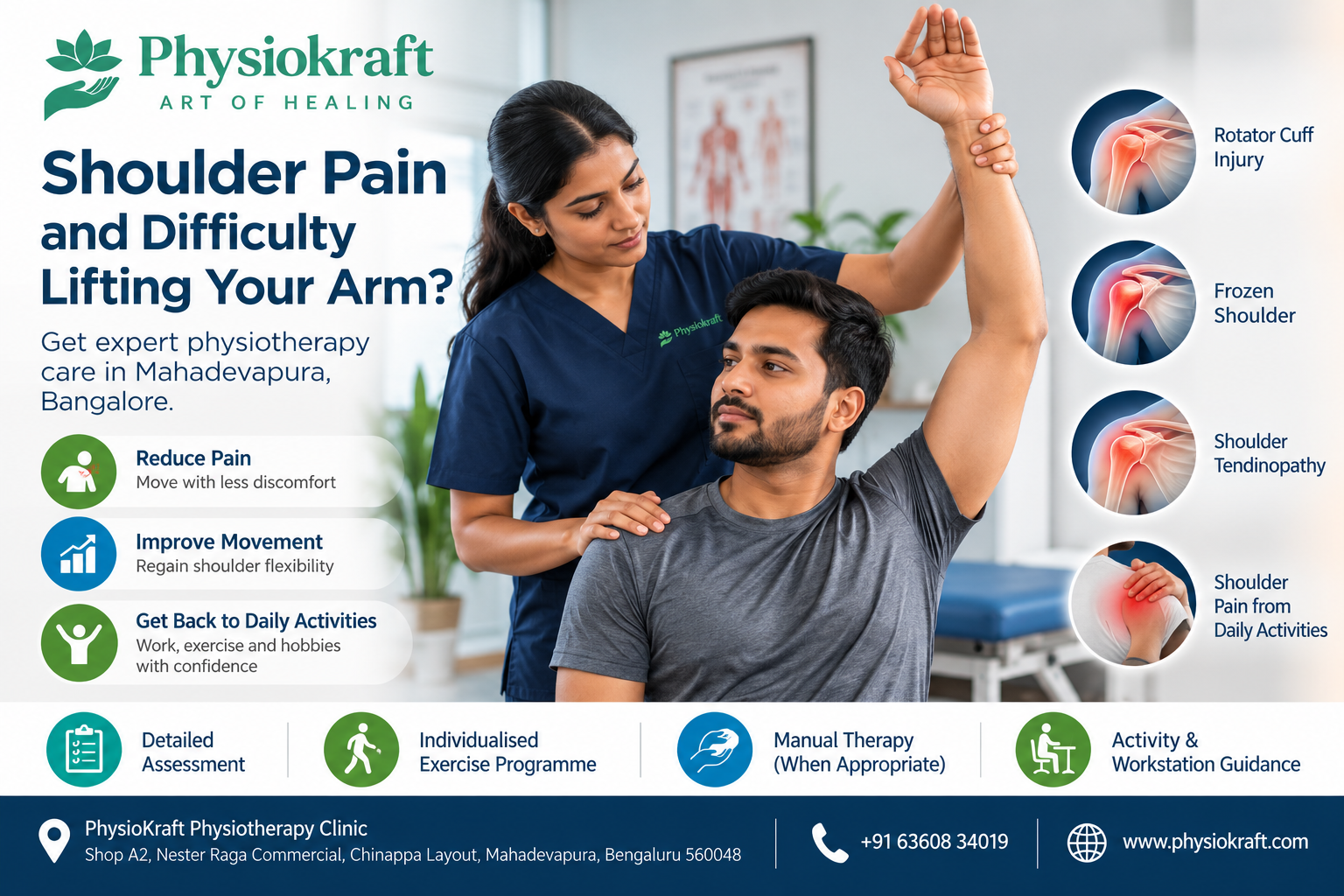


Shoulder pain after gym workouts can be frustrating, especially when you are trying to increase your strength, build muscle or maintain a consistent fitness routine. You may notice pain while doing bench presses, shoulder presses, lateral raises, pull-ups or even when lifting your arm after a workout.
While mild muscle soreness is common after challenging exercise, persistent shoulder pain, sharp discomfort or difficulty lifting your arm should not be ignored.
Weight training places considerable demands on the shoulder joint, rotator cuff muscles, biceps tendon and shoulder-blade muscles. A sudden increase in training intensity, repetitive loading, inadequate recovery or exercises that exceed your current capacity may contribute to shoulder problems.
The good news is that many gym-related shoulder conditions can improve with appropriate activity modification and a structured rehabilitation programme.
At PhysioKraft –Physiotherapy Clinic, Mahadevapura, Bangalore, we focus on identifying the reason behind your shoulder pain and developing an individualised rehabilitation plan to help you return to training safely.
What Causes Shoulder Pain After Gym Workouts?
Shoulder pain after Gym weight training can develop for several reasons. The location of pain, exercises that aggravate it, training history and physical examination findings all help determine the possible cause.
Here are six common reasons gym-goers experience shoulder pain.
1. Rotator Cuff-Related Shoulder Pain
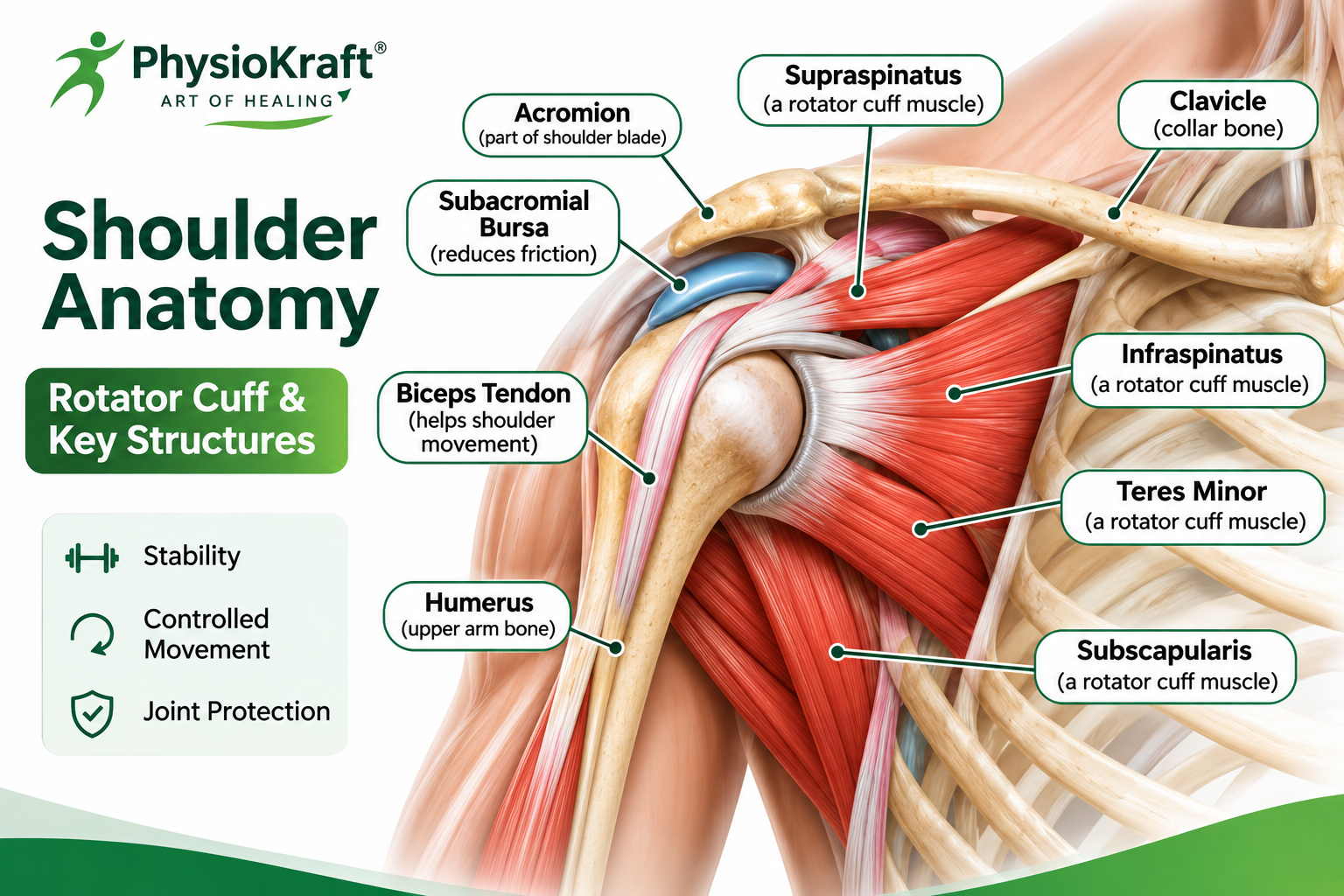
The rotator cuff is a group of four muscles and their tendons that help control shoulder movement and stabilise the shoulder joint.
These muscles work continuously during pressing, pulling and overhead exercises.
Exercises that load the rotator cuff include:
- Bench press
- Overhead shoulder press
- Dumbbell press
- Lateral raises
- Pull-ups
- Lat pulldowns
When training load increases faster than the shoulder can adapt, the rotator cuff may become painful and less tolerant to exercise.
You may experience pain while lifting your arm, performing overhead movements or lying on the affected shoulder.
Rehabilitation commonly focuses on education, appropriate activity modification and progressive strengthening based on the individual’s symptoms and functional capacity.
2. Shoulder Impingement or Subacromial Pain
Some people experience pain while raising their arm, particularly during movements above shoulder height.
This is often described as shoulder impingement or subacromial pain.
Common symptoms include:
- Pain during lateral raises
- Discomfort during overhead pressing
- Pain while reaching behind your back
- Difficulty lifting your arm sideways
- Shoulder discomfort after repetitive upper-body workouts
The term “impingement” is commonly used, but shoulder pain is not always caused by one structure being physically pinched. Several tissues and factors may contribute to symptoms.
A proper clinical assessment is more useful than relying on the label alone.
3. Rotator Cuff Tendinopathy
Repeated loading of the rotator cuff can lead to tendon-related pain and reduced tolerance to exercise.
You may notice:
- Pain during lifting exercises
- Discomfort during overhead activities
- Reduced shoulder strength
- Pain when sleeping on the affected side
- Difficulty returning to your previous gym weights
The 2025 clinical practice guideline for rotator cuff tendinopathy highlights the importance of appropriate assessment, patient education and exercise-based rehabilitation.
Treatment should be tailored to the individual’s symptoms, strength and functional requirements rather than following the same exercise routine for everyone.
4. Biceps Tendon Irritation
The long head of the biceps tendon passes through the shoulder region and helps contribute to shoulder function.
Repeated or excessive loading may irritate this tendon in some individuals.
Exercises that may aggravate symptoms include:
- Biceps curls
- Pull-ups
- Heavy rows
- Bench press
- Overhead exercises
Pain is often felt towards the front of the shoulder. Some people also notice discomfort when lifting objects or performing pulling movements.
5. Shoulder Instability
Shoulder instability occurs when the joint does not feel sufficiently secure during movement.
Some gym-goers describe a sensation that their shoulder is:
- Slipping or giving way
- Moving excessively
- Weak during pressing
- Unstable during overhead exercises
- Difficult to control under heavy loads
Shoulder instability can have different causes, including previous dislocation, ligament injury, inadequate muscular control or other structural problems.
A review of shoulder injuries in weightlifting athletes has discussed instability and overuse injuries, along with factors such as technique, vulnerable positions and excessive training loads.
If your shoulder repeatedly feels as though it may slip out of place, seek a proper assessment rather than continuing to lift through the symptoms.
6. Training Too Much, Too Soon
One common contributor to gym-related shoulder pain is increasing training volume or intensity faster than the body can adapt.
For example:
You normally bench press 40 kg but suddenly increase to 60 kg, add more chest exercises and train your shoulders several times a week.
The problem may not be one particular exercise. It may be the overall balance between training load, recovery and your current physical capacity.
Gradual progression is important when increasing weights, repetitions, sets or training frequency.
Which Gym Exercises Commonly Trigger Shoulder Pain?
Certain movements may aggravate shoulder symptoms, particularly when the load, technique, range of motion or training volume is not appropriate for the individual.
Commonly reported exercises include:
- Bench press and incline bench press
- Overhead shoulder press
- Dumbbell shoulder press
- Lateral and front raises
- Upright rows
- Pull-ups and lat pulldowns
- Dips and push-ups
- Heavy rows
- Olympic lifting movements
This does not mean these exercises are inherently harmful. The same exercise may be comfortable for one person and painful for another.
The important factors are your training history, technique, current capacity, symptoms and rehabilitation stage.
Shoulder Pain During Bench Press – What Should You Do?
Bench press is a popular exercise for developing chest, shoulder and triceps strength. However, some gym-goers experience shoulder pain after gym workouts at the front or side of the shoulder while lowering the bar or pushing the weight upwards.
Possible contributing factors include:
- Increasing the weight too quickly
- Training with excessive volume
- Using a range of motion that aggravates symptoms
- Poorly tolerated shoulder positioning
- Previous rotator cuff or shoulder injuries
- Insufficient recovery between demanding sessions

Should you stop bench pressing?
Not necessarily. However, continuing to perform painful repetitions without modification may aggravate your symptoms.
Consider these steps:
- Temporarily reduce the weight and avoid forcing painful repetitions.
- Review your grip width and bar path with a qualified trainer.
- Adjust the range of motion if the bottom position causes discomfort.
- Temporarily choose a more comfortable pressing variation if appropriate.
- Allow sufficient recovery between demanding upper-body sessions.
- Get assessed if the pain persists or repeatedly returns.
The aim is not to permanently avoid bench pressing. It is to understand why the movement hurts and progressively restore your ability to perform it comfortably.
Is Shoulder Pain After the Gym Normal?
Not every uncomfortable sensation after exercise indicates an injury.
After a challenging or unfamiliar workout, you may experience Delayed Onset Muscle Soreness (DOMS).
Typical DOMS:
- Develops several hours after exercise
- Often becomes most noticeable within 1–3 days
- Feels like muscle tenderness or stiffness
- Gradually improves with normal movement
However, sharp, persistent or worsening shoulder pain should not automatically be considered normal muscle soreness.
Pain associated with significant weakness, loss of movement or difficulty performing everyday activities deserves further assessment.
Should You Stop Going to the Gym Because of Shoulder Pain?
Not always.
Complete rest is not necessarily the best approach for every shoulder problem. Depending on the cause and severity, you may be able to continue training while modifying movements that aggravate your symptoms.
For example, lower-body training and some cardiovascular activities may remain possible while painful upper-body exercises are temporarily adjusted.
Your physiotherapist may help you decide:
- Which exercises to temporarily modify
- Which movements you can continue comfortably
- Whether your training volume needs adjustment
- How to gradually rebuild shoulder strength
- When to return to heavier pressing and pulling exercises
The goal is to restore your shoulder’s capacity rather than avoid movement indefinitely.
How Can Physiotherapy Help Shoulder Pain After Gym Workouts?
Physiotherapy can help identify the factors contributing to shoulder pain and guide your recovery.
At PhysioKraft, a physiotherapy assessment may include:
- Shoulder range-of-motion assessment
- Rotator cuff strength testing
- Shoulder-blade movement assessment
- Functional movement assessment
- Identification of painful or restricted movements
- Training-load and exercise-history review
- Assessment of relevant gym movements
- Evaluation of your goals and return-to-training requirements
Based on the findings, your physiotherapist can develop an individualised treatment and rehabilitation programme.
1. Advanced Manual Therapy
Manual therapy may be used as part of an individualised rehabilitation plan when clinically appropriate.
Depending on your assessment, treatment may include selected joint mobilisation and soft-tissue techniques to help address pain, mobility restrictions and movement-related symptoms.
Manual therapy is generally best considered an adjunct to active rehabilitation rather than a replacement for strengthening and functional exercise.
2. Progressive Strengthening
Exercise-based rehabilitation is an important part of managing many rotator cuff-related shoulder problems.
Your programme may gradually address:
- Rotator cuff strength
- Shoulder muscle strength
- Scapular control
- Neuromuscular coordination
- Functional strength
- Sport- and gym-specific movements
The exercise selection and resistance should match your current ability and symptoms.
3. Shoulder Mobility and Movement Training
If restricted movement contributes to your symptoms, suitable mobility exercises may be included.
The goal is to improve comfortable shoulder movement and prepare the joint for progressively demanding activities.
4. Return-to-Gym Rehabilitation
Returning to your normal gym routine should be gradual.
A rehabilitation plan may progress from comfortable daily movements to controlled strengthening, modified gym exercises and eventually more demanding lifting tasks.
Your progress should be based on pain, movement, strength and tolerance to training rather than an arbitrary recovery deadline.
What Exercises May Help Shoulder Pain?
The appropriate exercises depend on the underlying problem and your current capacity.
A physiotherapist may include:
External rotation exercises: These target the rotator cuff and can help progressively restore shoulder strength.
Scapular strengthening: Exercises for the muscles around the shoulder blade may help improve shoulder function and movement control.
Progressive resistance training: Resistance can be increased gradually as your shoulder becomes more tolerant to loading.
Mobility exercises: Appropriate mobility work may be included when restricted movement is contributing to symptoms.
An exercise that helps one person may aggravate another. Avoid copying a generic shoulder exercise routine if an exercise consistently increases your pain.
How Long Does Shoulder Pain After Gym Take to Recover?
Recovery depends on the cause and severity of the problem.
Mild exercise-related irritation may settle within days, while tendon-related pain or a more significant injury may require several weeks or longer.
Factors that can influence recovery include:
- Severity and duration of symptoms
- Shoulder strength and mobility
- Training volume and intensity
- Previous shoulder injuries
- Sleep and recovery
- Exercise technique
- Consistency with rehabilitation
Instead of focusing only on a fixed number of days, look for gradual improvements in pain, movement, strength and exercise tolerance.
When Should You See a Physiotherapist for Shoulder Pain?
Consider getting your shoulder assessed if:
- Pain continues for more than a few days after training.
- Shoulder pain repeatedly returns after workouts.
- You have difficulty lifting your arm.
- Your shoulder feels weak.
- You experience pain while sleeping.
- You cannot perform your usual gym exercises.
- Your shoulder feels unstable or gives way.
- Your strength has suddenly decreased.
- Symptoms are progressively getting worse.
Seek urgent medical assessment if you have experienced a significant fall or traumatic injury, the shoulder appears deformed, you cannot move your arm after an injury, or you develop severe swelling or sudden significant weakness. Chest pain or breathing difficulty accompanying shoulder pain also requires urgent medical attention.
How to Prevent Shoulder Pain at the Gym
You can reduce the likelihood of training-related shoulder problems by following sensible training principles.
1. Warm Up Before Heavy Lifting
Prepare your body with general movement and exercise-specific warm-up sets before demanding workouts.
2. Increase Training Load Gradually
Avoid sudden increases in weight, repetitions, sets or weekly training frequency.
3. Prioritise Exercise Technique
Use a movement pattern that is appropriate for your body, experience and current capacity. If you are unsure, ask a qualified trainer or physiotherapist to assess your technique.
4. Do Not Train Through Increasing Pain
If a particular movement repeatedly increases your pain, modify it rather than forcing the exercise.
5. Allow Adequate Recovery
Your body needs recovery between demanding training sessions. Adequate sleep and sensible spacing of workouts can support training consistency.
6. Strengthen the Whole Shoulder System
A balanced programme should not focus only on the chest and deltoids. It should also consider the rotator cuff and muscles responsible for controlling the shoulder blade.
Sports Physiotherapy for Gym-Related Shoulder Pain in Mahadevapura, Bangalore
If you are experiencing shoulder pain after gym workouts, getting the right assessment can help you understand what is contributing to your symptoms and how to return to exercise safely. If you are searching shoulder pain physiotherapy Banglore
At PhysioKraft – Physiotherapy Clinic, Mahadevapura, we provide physiotherapy assessment and rehabilitation for people experiencing shoulder pain after gym, rotator cuff-related problems, gym injuries and sports-related musculoskeletal conditions.
Our approach focuses on:
- Individualised shoulder assessment
- Advanced manual therapy when appropriate
- Progressive strengthening and exercise rehabilitation
- Shoulder mobility and movement control
- Training-load modification
- Functional and gym-specific rehabilitation
- Gradual return to exercise and sports
We serve individuals from Mahadevapura and nearby areas, including Whitefield, Hoodi and Doddanekundi.
Our aim is to help you understand your shoulder problem, improve your movement and rebuild the strength required for your fitness goals.
PhysioKraft – Where Touch Meets Clinical Science.
Frequently Asked Questions
1. Is Shoulder pain after gym training normal?
Mild muscle soreness can occur after a new or demanding workout. However, persistent, sharp or worsening shoulder pain should not automatically be considered normal post-workout soreness.
2. Should I stop bench pressing if my shoulder hurts?
Not necessarily. You may need to temporarily modify the weight, range of motion, grip, frequency or exercise selection. A physiotherapy assessment can help determine what is appropriate.
3. Can I train other body parts with shoulder pain?
Often, yes, depending on the underlying problem. Lower-body and cardiovascular training may remain possible while painful upper-body exercises are modified.
4. Can physiotherapy help shoulder pain after gym?
Many gym-related shoulder problems can be managed with education, activity modification and progressive rehabilitation. The appropriate treatment depends on the assessment findings and the underlying condition.
5. How long should I rest my shoulder?
There is no universal number of rest days. Prolonged complete rest is not always required. The goal is generally to modify aggravating activities and gradually restore strength and function.
6. Can I exercise with rotator cuff pain?
In many cases, appropriately selected exercise is part of rehabilitation. However, the exercise selection and loading level should be adjusted according to your symptoms and functional capacity.
7. Are shoulder presses bad for your shoulders?
No. Shoulder presses are not inherently harmful. Problems can occur when exercise selection, technique, load, volume or recovery do not match your current capacity.
8. Can I prevent shoulder injuries while lifting weights?
You can reduce risk by progressing gradually, using appropriate technique, managing training volume, recovering adequately and addressing persistent symptoms early.
Get Your Shoulder Pain Assessed at PhysioKraft
Shoulder pain after gym or weight training does not always mean you have to stop exercising.
The important step is identifying why your shoulder is painful and adjusting your training appropriately.
A structured rehabilitation programme can help restore shoulder mobility, strength and confidence while gradually preparing you to return to your normal gym activities.
If you are looking for shoulder pain physiotherapy Bangalore, visit PhysioKraft for an individualised assessment and rehabilitation plan.
PhysioKraft Physiotherapy Clinic
Mahadevapura, Bengaluru, Karnataka
Website: www.physiokraft.com
Phone: +91 6360834019
Don’t ignore persistent shoulder pain. Get it assessed and work towards a safe return to training.
References & Recent Evidence
- Desmeules F, et al. Rotator Cuff Tendinopathy Diagnosis, Nonsurgical Medical Care, and Rehabilitation: A Clinical Practice Guideline. Journal of Orthopaedic & Sports Physical Therapy. 2025;55(4):235–274. PubMed
- Zhang B, et al. Addressing Shoulder Weakness in Individuals With Rotator Cuff-Related Shoulder Pain: A Systematic Review With Meta-analysis. Journal of Orthopaedic & Sports Physical Therapy. 2026;56(2):67–84. PubMed
- Wu Y, et al. Specific modes of exercise to improve rotator cuff-related shoulder pain: systematic review and meta-analysis. 2025. PubMed
- Tena-Portilla A, et al. Effectiveness of exercise in rotator cuff-related shoulder pain: a systematic review with meta-analysis. Physiotherapy Theory and Practice. 2026. PubMed
- Daher M, et al. Shouldering the load: A scoping review of incidence, types, and risk factors of shoulder injuries in weight-lifting athletes. Shoulder & Elbow. 2025;17(3):254–263. PubMed
- Salamh P, et al. Risk Factors Associated With New Onset of Shoulder Pain and Injury Among the Athletic Population: A Systematic Review of the Literature. International Journal of Sports Physical Therapy. 2025;20(3):315–332.